Supply Chain Disruptions: How Small Factories Can Build Resilience Without Big-Co Budgets
Disruption is the default now, and small factories feel it most. But resilience isn't about spending more - it's about visibility, prioritization, and speed. Here's how to build it on a small-business budget.

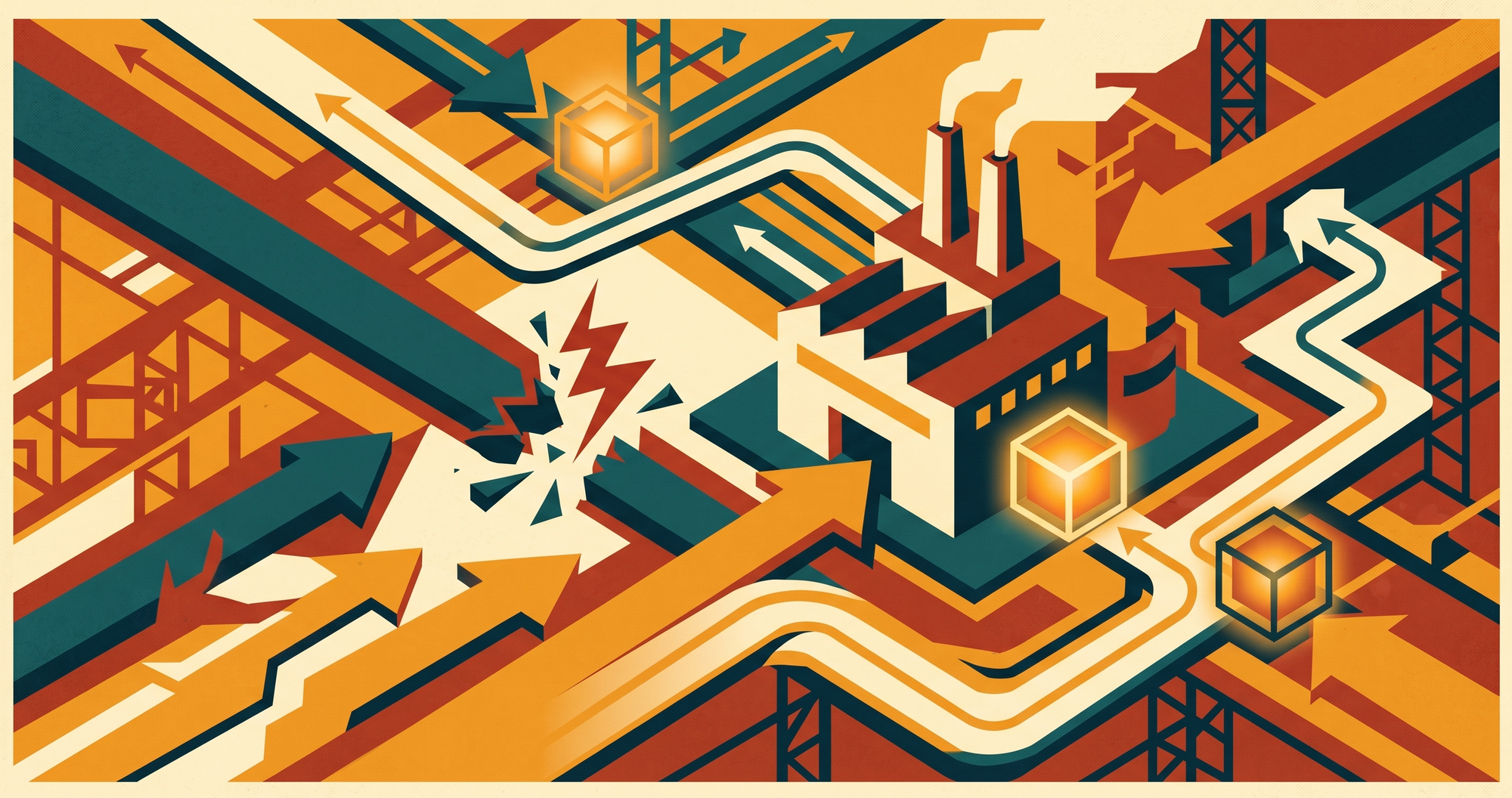
TL;DR: Supply chain disruption is no longer a rare event - it's the operating environment. Large manufacturers absorb it with expensive buffers, dedicated risk teams, and enterprise software. Small factories can't, but they don't have to be fragile either. Resilience for a small manufacturer isn't about spending more; it's about visibility, prioritization, and knowing what's actually happening on your floor faster than disruption can hurt you. This post lays out how small factories can build real supply chain resilience on a small-business budget.
Disruption Is the Default Now
For most of my career, supply chain disruption was treated as the exception - the once-in-a-while crisis you scrambled to manage and then went back to normal. That framing is gone. Between global shocks, shipping volatility, supplier instability, and demand swings, disruption isn't the exception anymore. It's the weather.
Large manufacturers have responded the way large manufacturers do: dedicated supply chain risk teams, sophisticated forecasting platforms, expensive safety stock held across multiple sites, and the balance sheet to absorb a bad quarter. I spent two decades working on that side of the divide - building and running the kind of enterprise infrastructure that's supposed to make a big company disruption-proof.
Here's what I learned that's directly useful to a small manufacturer: most of that expensive infrastructure is solving for scale, not for resilience itself. The actual principles of resilience - see problems early, know what matters most, respond fast - don't require an enterprise budget. They require discipline and visibility. And those, a small factory can absolutely afford.
Why Small Factories Feel More Fragile
It's worth being honest about why disruption hits small manufacturers harder, because understanding the vulnerability is the first step to fixing it.
Thinner buffers. A large manufacturer can hold weeks of safety stock across the supply chain. A small factory's cash is tied up in the business; it can't afford to sit on inventory as insurance. So when a supplier slips, there's less cushion before it hits production.
Less supplier leverage. When a critical component is scarce, the big buyers get served first. A small manufacturer is further down the priority list, which means disruptions last longer for them.
No dedicated risk function. There's no supply chain risk team watching the horizon. The same person running operations is also fighting today's fires, so disruptions tend to get noticed late - when they're already affecting the floor.
Tighter interdependencies. In a small operation, one missing material can stop a larger share of total output. There's less ability to reroute work around the problem.
None of these vulnerabilities are about a lack of money to throw at the problem. They're about visibility and responsiveness - and that reframing is what makes resilience affordable. You can't out-spend a big manufacturer on buffers. But you can out-see and out-react them, because a small operation can move faster once it knows what's happening.
What Resilience Actually Means (It's Not Just More Inventory)
The instinct, when you feel fragile, is to hold more stock. More safety stock feels like more security. But for a small manufacturer, that instinct is a trap - it ties up the cash you need to stay flexible, and it doesn't actually address the root vulnerability, which is not knowing soon enough.
Real resilience rests on three capabilities, none of which is primarily about holding more inventory:
1. Early visibility. Seeing a developing problem - a bin running low, a supplier slipping, consumption running ahead of plan - while there's still time to act, rather than discovering it when the line stops.
2. Prioritization. Knowing which materials, suppliers, and items actually matter - the ones that stop production when they fail - so your limited attention and limited buffers go where they count.
3. Fast response. Being able to act quickly once you see a problem, because speed of reaction is the one structural advantage a small operation has over a large one.
Notice that all three are about information and decision-making, not about spending. A big manufacturer buys resilience with buffers. A small manufacturer earns it with visibility and speed. That's a budget you can actually meet.
Deploy in minutes, not months
Solve your biggest shop floor problem this week.
Fabyra gives you modular, AI-powered apps for downtime, inventory, production pacing, and maintenance - with Fabyra AI, your built-in agent, surfacing the insights you'd otherwise miss. Pick only what you need. Free tier forever, no hardware, no IT project.
✓ Free tier forever · ✓ Deploy in minutes · ✓ No IT department needed
Building Resilience on a Small Budget: The Practical Moves
Here's how those three capabilities translate into concrete actions a small factory can take without an enterprise budget.
Know Your Critical Few
You cannot protect everything, and trying to is how small operations waste their limited resilience budget. The first move is identifying the critical few: the materials and components that, when they're unavailable, actually stop production.
Most factories find that a small fraction of their materials account for the overwhelming majority of their disruption risk. Those are the ones worth watching closely, holding modest buffers of, and lining up backup suppliers for. Everything else can be managed loosely. This is the single highest-leverage move in small-factory resilience: concentrate your limited protection where a failure actually hurts.
Get Real-Time Visibility on What You Have
You can't respond early to a problem you can't see. The most common way small factories get blindsided is simple: they don't know a critical material is running low until it's gone, because the count lives in a spreadsheet that's days out of date or in someone's head.
Real-time visibility on your critical items changes the game. When you can see actual consumption and current levels as they happen - and get an alert before a critical item runs out - a looming shortage becomes a routine reorder instead of an emergency. This is exactly the inventory blind spot problem at the heart of resilience: disruption hurts most when it's invisible until too late.
Diversify the Suppliers That Matter
You don't need a second source for everything - that's expensive and unnecessary. You need a backup for the critical few. For the handful of components that can stop your line, knowing a second supplier exists, is qualified, and can deliver in a pinch turns a single point of failure into a manageable risk. This is targeted diversification, not blanket redundancy - affordable precisely because it's focused only where it matters.
Hold Smart Buffers, Not Big Ones
Buffers still have a role - but a precise one. Instead of holding more of everything, hold modest safety stock only on your critical few, sized to your actual lead-time risk. A small, targeted buffer on the items that stop production protects you far more, per dollar tied up, than a large undifferentiated pile of inventory. Resilience isn't the absence of buffers; it's putting them exactly where they earn their keep.
Use the Speed You Already Have
A small factory's structural advantage is speed. There's no committee, no multi-site coordination, no slow approval chain. When you see a problem early, you can act on it immediately - switch suppliers, adjust the schedule, expedite an order - in hours, not weeks. The whole resilience strategy is built to exploit this: see early (visibility), know what matters (prioritization), and then use the responsiveness a big company structurally can't match.
The Role of Visibility Technology
Everything above depends on one thing: knowing what's actually happening, in real time, on your floor and in your inventory. That's a visibility problem, and visibility is where affordable technology makes the biggest difference for a small manufacturer.
You don't need an enterprise supply chain risk platform. You need real-time visibility on your critical materials - current levels, actual consumption, and alerts before something runs out. BinTrack, the inventory module in the Fabyra suite, was built for exactly this: real-time, bin-level visibility on high-value items, with low-stock alerts, without the cost or complexity of an enterprise system.
And because it feeds Fabyra AI, the resilience questions you'd otherwise have to dig for become a quick ask: "which critical materials are below threshold right now?" or "which items have we consumed faster than planned this week?" - turning real-time data into early warning, which is the entire foundation of resilience. The factory that gets the alert on Tuesday handles a routine reorder; the one that discovers the shortage on Friday loses the shift. That difference is what visibility technology buys you, and it's affordable.
A Resilience Checklist for Small Manufacturers
If you want a place to start, work through these:
- Identify your critical few - the materials and components that stop production when unavailable.
- Get real-time visibility on those critical items - current levels, consumption, and low-stock alerts.
- Line up backup suppliers for the critical few only - qualified and ready, not necessarily active.
- Hold smart buffers - modest safety stock sized to lead-time risk, on critical items only.
- Build the response habit - when an early warning fires, act on it immediately; don't let it wait.
- Review after every disruption - what did you see late that you could have seen early? Tighten the visibility there.
None of these requires a big budget. All of them require knowing what's happening before it becomes a crisis - which is what resilience actually is.
Frequently Asked Questions
What is supply chain resilience for a small manufacturer? Supply chain resilience is the ability to absorb and respond to disruptions - supplier delays, material shortages, demand swings - without losing production. For a small manufacturer, it's built less on large inventory buffers and more on early visibility (seeing problems coming), prioritization (knowing which materials matter most), and fast response (acting quickly), because those capabilities don't require an enterprise budget.
How can a small factory build supply chain resilience on a budget? Focus on the critical few materials that stop production when unavailable, get real-time visibility on their levels with low-stock alerts, line up backup suppliers for just those items, hold modest targeted buffers, and use the fast response speed a small operation naturally has. Resilience for a small factory comes from information and responsiveness, not from outspending larger competitors on inventory.
Does building resilience mean holding more inventory? Not primarily. Holding more of everything ties up cash a small manufacturer needs to stay flexible, and it doesn't fix the root problem of not knowing about shortages soon enough. Smart resilience uses modest, targeted buffers only on critical items, combined with real-time visibility and fast response. The goal is seeing problems early, not stockpiling against all of them.
What's the most important first step toward supply chain resilience? Identifying your critical few - the small set of materials and components that actually stop production when they're unavailable. Most factories find a small fraction of materials account for most disruption risk. Concentrating your visibility, backup suppliers, and buffers on those items is the highest-leverage move, because it focuses limited resources exactly where a failure hurts.
How does inventory visibility improve supply chain resilience? Real-time visibility turns a looming shortage into a routine reorder instead of an emergency. When you can see actual consumption and current levels of critical materials - and get alerted before something runs out - you act early, while there's still time. Most disruption damage to small factories comes from discovering a shortage too late; visibility is what moves the discovery earlier.
Do small manufacturers need enterprise supply chain software? Usually not. Enterprise supply chain risk platforms solve for scale and complexity that small operations don't have. What a small manufacturer actually needs is affordable real-time visibility on its critical materials - current levels, consumption, and alerts - which lightweight tools like BinTrack provide without enterprise cost or implementation.
The Bottom Line
Disruption is the default now, and small factories feel it more sharply than large ones - thinner buffers, less leverage, no dedicated risk team. But fragility isn't fixed by spending money you don't have on inventory you can't afford to sit on.
Resilience for a small manufacturer is built on three things a small budget can buy: seeing problems early, knowing which problems matter most, and responding faster than the disruption can hurt you. The big manufacturer buys resilience with buffers. You earn it with visibility and speed - and speed is the one advantage you already have over them.
Protect the critical few. See what's happening in real time. Act before the shortage becomes a stoppage. That's resilience on a small-business budget - and in an environment where disruption is the weather, it's not optional.
Deploy in minutes, not months
Solve your biggest shop floor problem this week.
Fabyra gives you modular, AI-powered apps for downtime, inventory, production pacing, and maintenance - with Fabyra AI, your built-in agent, surfacing the insights you'd otherwise miss. Pick only what you need. Free tier forever, no hardware, no IT project.
✓ Free tier forever · ✓ Deploy in minutes · ✓ No IT department needed
Ruth Sinvani is a co-founder of Fabyra with 20+ years in supply chain and manufacturing operations, including leading a €200M automated distribution center launch.