From Receiving Dock to Production Line: Mapping Your Material Flow
Between the receiving dock and the operator's hands, material takes a journey most manufacturers never map - full of waiting, double-handling, and blind spots. Here's how to map it this week with a clipboard.

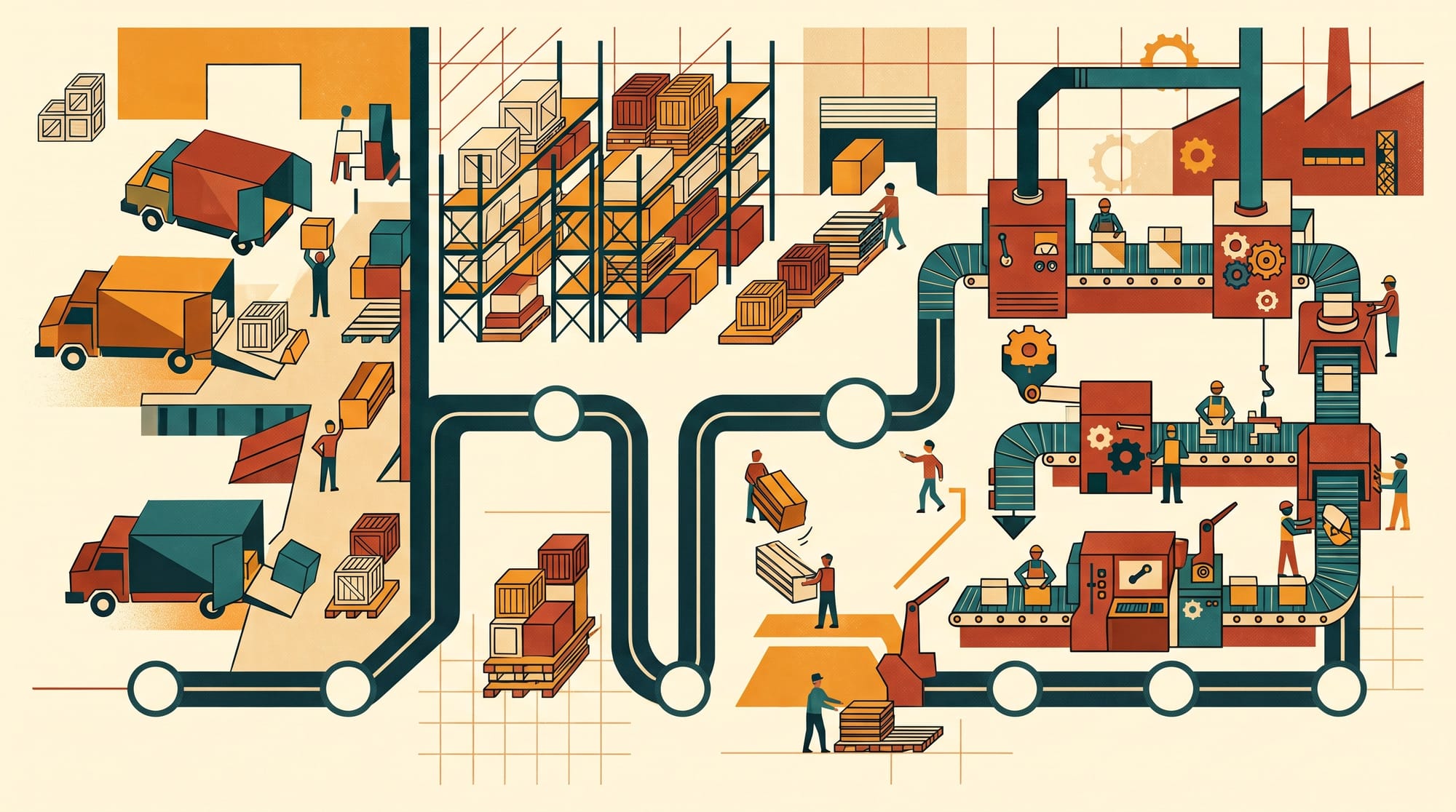
TL;DR: Between the moment material arrives at your receiving dock and the moment it reaches the operator's hands, it takes a journey most manufacturers have never actually mapped. That unmapped journey is full of waiting, double-handling, and blind spots - and it's where a surprising amount of production delay is born. This post walks through how to map your material flow step by step, what to look for at each stage, and how to fix the bottlenecks you'll find. It's a practical exercise you can run this week with a clipboard, and one that pays off for years.
The Journey Nobody Maps
Every manufacturer can tell you how their product gets made. Ask about the production sequence - cut, weld, assemble, test, pack - and you'll get a confident, detailed answer.
Ask a different question: "What exactly happens to a box of components between the moment it's unloaded at the dock and the moment an operator uses it on the line?" - and the confidence usually fades. That journey is rarely mapped, rarely measured, and rarely questioned. It just... happens. Material shows up, gets put somewhere, and eventually makes its way to where it's needed, through a series of handoffs and moves that nobody designed on purpose.
I spent two decades on the logistics and warehouse side of manufacturing, and this is the part I learned to look at first. Because the production sequence is usually well-optimized - people obsess over it. The material flow feeding that sequence is where the hidden waste lives. It's the dark matter of the shop floor: invisible, unmeasured, and far larger than anyone expects.
Mapping it is one of the highest-return exercises a small manufacturer can do. And it costs nothing but attention.
What Is Material Flow?
Material flow is the complete path a physical item takes through your facility - from the instant it arrives to the instant it's consumed in production (and onward to finished goods, but we'll focus on the inbound-to-line journey here, because that's where small manufacturers bleed the most time).
It includes every physical state and movement:
- Arrival and unloading at the receiving dock
- Inspection and acceptance
- Put-away into storage
- Storage itself (the waiting)
- Retrieval when production needs it
- Transport to the line or cell
- Staging at the workstation
- Consumption by the operator
Each of those steps takes time, consumes labor, and creates an opportunity for something to go wrong - a delay, a loss of visibility, a misplacement. The goal of mapping is simple: make the whole journey visible so you can see where the time and the risk actually accumulate.
The principle underneath this comes straight from lean thinking: material should flow, not sit. Every moment material is stationary or being handled without adding value is waste. But you can't attack that waste until you can see the flow - and most manufacturers have never drawn it.
Why Material Flow Mapping Matters
Before we get into the how, it's worth being concrete about what this exercise actually buys you.
It reveals the waiting. Material spends the vast majority of its time in your facility doing nothing - sitting in storage, waiting to be moved, staged but not yet used. Mapping shows you how much, and where.
It exposes double-handling. In an unplanned flow, material often gets moved more times than necessary - staged in one place, then re-staged in another, then moved again. Each handling is labor spent and risk added. Mapping makes redundant moves obvious.
It surfaces the blind spots. Remember the inventory blind spots that stop production? Most of them are born in material flow - the moment material moves from a tracked location to an untracked one is the moment it can go missing. Mapping shows you exactly where visibility drops.
It connects the warehouse to the line. This is the seam I care about most: the handoff from "material is in storage" to "material is at the workstation." That transition is where the supply chain meets the shop floor, and it's precisely where most manufacturers have no system watching. Mapping the flow forces you to look right at that seam.
It makes bottlenecks measurable. Once the flow is mapped and timed, the bottleneck stops being a matter of opinion and becomes a matter of data. You know which step is slowest, which is riskiest, which is costing you the most.
How to Map Your Material Flow: A Step-by-Step Guide
Here's the practical exercise. You can do the first pass in a single day with nothing more than a clipboard, a pen, and a willingness to follow material around your facility.
Step 1: Pick One Material to Follow
Don't try to map everything at once. Choose a single, representative material - ideally one of your critical few, the high-value or line-stopping items that matter most. Follow that one item's journey completely before expanding. One clear map beats ten half-finished ones.
Step 2: Walk the Physical Path
Literally walk it. Start at the receiving dock and physically follow the route the material takes to the line, step by step. Don't sit in an office and draw it from memory - memory is where the double-handling and the detours hide. Walk the actual path, and note every place the material stops, gets handled, or changes hands.
Step 3: Record Every Step, Handoff, and Wait
At each stage, write down three things: what happens, how long it takes (or waits), and who's responsible. Capture every touch - every time someone picks the material up, moves it, sets it down, or logs it. Pay special attention to the waits: how long does material sit at each stage before the next thing happens?
Step 4: Mark Where Visibility Is Lost
As you walk, flag every point where the material stops being tracked. Is it logged when it arrives? When it's put away? When it moves to the line? Somewhere in most facilities, the material drops off the system's radar - mark exactly where. That blind spot is a prime suspect for future shortages.
Step 5: Time the Value-Add vs. the Waiting
Now add up two numbers: the total time from dock to line, and the fraction of that time the material was actually being worked on versus simply waiting or moving. The ratio is almost always shocking - material typically spends a tiny fraction of its journey adding value and the vast majority waiting. That gap is your opportunity.
Step 6: Identify the Bottlenecks and Fixes
With the map in front of you, the problems become obvious. Look for the longest waits, the redundant handoffs, the visibility gaps, and the steps where material regularly gets lost or delayed. Rank them by impact. These are your targets.
What You'll Probably Find
Every facility is different, but after mapping many of them, the same patterns show up again and again. Here's what to expect:
Material sits far longer than it moves. The waiting-to-working ratio is almost always lopsided. This is normal - but seeing the actual number usually motivates real change.
There's at least one redundant handoff. Somewhere, material gets moved to an intermediate spot for no reason other than "that's how it's always been." Removing it is often a quick win.
Visibility drops at the warehouse-to-line handoff. The most common blind spot is the transition from storage to the workstation. Material is tracked in storage, tracked (maybe) at consumption, but invisible in between - which is exactly when it gets misplaced or double-pulled.
Staging is where things go missing. Material staged near the line but not yet consumed often lives in an untracked limbo. It's out of the storage system but not yet logged as used, so it's effectively invisible.
The bottleneck isn't where people think. Managers usually guess the bottleneck is at retrieval or transport. More often, it's a waiting step nobody noticed - material sitting staged, or waiting for inspection, or queued for a forklift.
Deploy in minutes, not months
Solve your biggest shop floor problem this week.
Fabyra gives you modular, AI-powered apps for downtime, inventory, production pacing, and maintenance — with Fabyra AI, your built-in agent, surfacing the insights you'd otherwise miss. Pick only what you need. Free tier forever, no hardware, no IT project.
✓ Free tier forever · ✓ Deploy in minutes · ✓ No IT department needed
From Map to Improvement
A map is only valuable if it drives change. Once you can see your material flow, the improvements tend to fall into a few categories:
Eliminate steps. The fastest win is removing redundant handoffs entirely. If material is staged twice, find a way to stage it once. Every eliminated handling is labor saved and risk removed.
Shorten the waits. Attack the longest waiting stages. Can material move to the line closer to when it's needed rather than sitting staged for hours? Can inspection happen faster or in parallel?
Close the visibility gaps. Wherever the map shows material dropping off the radar, add lightweight tracking. This is exactly the seam where real-time inventory visibility pays off - capturing material as it moves from storage toward the line, so it never disappears into the blind spot between systems.
Connect flow to production signals. The deepest improvement is linking material flow to what's actually happening on the line. When a line's pace or its downtime is being tracked, you can correlate stoppages against material arrivals and finally see how often the line waits on material. That correlation - material flow meeting production execution - is where the supply chain and the shop floor become one connected picture.
This is the role a lightweight execution layer plays. BinTrack captures material as it moves and gets consumed, closing the storage-to-line visibility gap, while the rest of the Fabyra suite tracks what happens on the line itself. Ask Fabyra AI "how often did line stoppages line up with material arriving late this month?" and the two halves of the map - material flow and production reality - become a single answer.
Frequently Asked Questions
What is material flow in manufacturing? Material flow is the complete physical path an item takes through a facility, from arrival at the receiving dock through inspection, storage, retrieval, transport, and staging, to its consumption on the production line. It covers every movement, handoff, and wait along the way. Understanding material flow means seeing where material moves, where it sits, and where it loses visibility between the warehouse and the line.
How do you map material flow in a small factory? Pick one representative material (ideally a critical, line-stopping item) and physically walk its path from the receiving dock to the production line. Record every step, handoff, and wait - noting how long each takes and who's responsible. Mark where the material stops being tracked, then compare how much time it spends being worked on versus simply waiting. The result reveals bottlenecks, redundant handling, and visibility gaps.
Why is material flow mapping important? Because the journey from dock to line is usually unmapped and full of hidden waste - long waits, redundant handoffs, and points where material loses visibility and goes missing. The production sequence itself is typically well-optimized, but the material flow feeding it is where small manufacturers lose the most time. Mapping makes that waste visible and measurable so it can be eliminated.
What's the most common problem material flow mapping reveals? The most common finding is that material spends the overwhelming majority of its time waiting or being moved rather than adding value, and that visibility drops at the handoff from storage to the production line. This warehouse-to-line seam is where material most often gets misplaced, double-handled, or double-pulled, because it's tracked in storage and (maybe) at consumption but invisible in between.
How is material flow related to production downtime? Material flow problems are a frequent, under-recognized cause of downtime. When material isn't at the workstation when needed - because it's staged in the wrong place, lost in a visibility gap, or delayed in transit - the line stops. These stoppages often get blamed on the machine or the operator, when the real cause is upstream in the material flow. Tracking both material movement and line downtime reveals how often they're connected.
Can you map material flow without special software? Yes - the initial mapping exercise needs nothing more than a clipboard and a walk through your facility following one material from dock to line. Software isn't required to see the flow. However, once you've identified where visibility drops, lightweight tracking tools help you close those gaps permanently and keep the flow visible in real time, rather than re-mapping by hand each time.
The Bottom Line
The path material takes from your receiving dock to your production line is one of the most overlooked parts of a manufacturing operation - and one of the most rewarding to examine. While everyone focuses on optimizing the production sequence, the material flow feeding that sequence quietly accumulates waiting, double-handling, and blind spots that stop the line and drain margin.
You can map it this week. Pick one material, walk its journey, record every step and wait, mark where visibility drops, and time the value-add against the waiting. The map you produce will show you exactly where your dock-to-line flow is costing you - and most of the fixes cost nothing but the decision to change how material moves.
Material should flow, not sit. Map the journey, close the gaps, and connect what's moving through your warehouse to what's happening on your line. That's where the supply chain and the shop floor finally become one picture.
Deploy in minutes, not months
Solve your biggest shop floor problem this week.
Fabyra gives you modular, AI-powered apps for downtime, inventory, production pacing, and maintenance — with Fabyra AI, your built-in agent, surfacing the insights you'd otherwise miss. Pick only what you need. Free tier forever, no hardware, no IT project.
✓ Free tier forever · ✓ Deploy in minutes · ✓ No IT department needed
Ruth Sinvani is a co-founder of Fabyra with 20+ years in supply chain and manufacturing operations, including leading a €200M automated distribution center launch.